Cascais-Portugal.com
The best independent guide to Cascais
Cascais-Portugal.com
The best independent guide to Cascais
Lisbon to Cascais and Cascais to Lisbon by train in 2026
Cascais is a charming fishing town situated on a beautiful stretch of coastline. The town is filled with grand 19th-century villas, fascinating museums and an abundance of Portuguese charm. As well as being one of the most popular holiday destinations in Portugal, it also makes a fantastic day trip from Lisbon.
Cascais is located 27km to the west of Lisbon and is connected by the ‘Linha de Cascais’ urban railway, which provides a regular and inexpensive train service. This train departs from Cais do Sodré train station in Lisbon and terminates in the centre of Cascais.
Another option for the journey is to use a ride-hailing app (such as Uber or Bolt), with the typical fare costing just €25-€35. Uber and Bolt provide the convenience of door to door, however there can be very high demand in the later afternoon.
If you are in Cascais for a holiday, the railway makes it very easy to visit Lisbon as a day trip. An added benefit is that it passes through the Belém district, one of my favourite areas of Lisbon.
For those arriving at Lisbon Airport and heading directly to Cascais, you will need to cross Lisbon by metro or Uber to Cais do Sodré train station.
Having lived in Lisbon since 2020 and married to my Portuguese wife, I make this journey regularly, whether it is a beach day with friends, sightseeing with my young family or the rush hour commute for work. This guide will help you plan and make the journey to Cascais hassle-free and is based on my first-hand experience.
Related articles: Introduction to Cascais - Day trip to Cascais

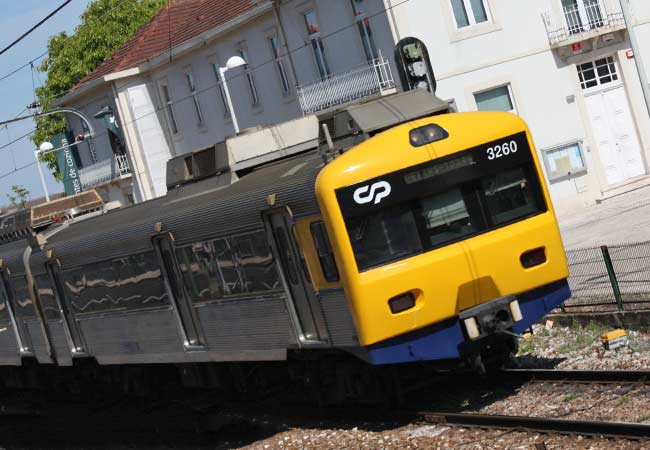
The train to Cascais passing through the Belem district of Lisbon.
Lisbon to Cascais by train for a day trip
The best choice for travelling from Lisbon to Cascais depends on your budget and circumstances. For a straightforward day trip, the train is the best option. However, if you are willing to spend around €55–60 return, an Uber provides far more convenience, particularly if you are short on time or travelling with children.
The train is the best public transport option for travelling from Lisbon to Cascais, and the Linha de Cascais railway serves all of the towns and beaches on the northern side of the Tejo estuary, between Algés in the east and Cascais in the west.
The downside with the train is that it can get very busy during the summer as everyone heads to (and returns from) the beach. From experience, this means long queues to buy tickets, and trains heading back to Lisbon can be crowded.
In Lisbon, the train departs from Cais do Sodré train station, which is to the west of the historic centre (GPS: 38.705, -9.145 - link to Google Maps). Cais do Sodré station is connected to the green metro line. Cascais is the final stop of the route, and the station lies in the centre of the town (GPS: 38.700, -9.418), just a short walk to the shops and beaches.

The Cais do Sodré train station
Fares
The Lisbon-Cascais railway is operated by Comboios de Portugal (CP), the national train operator of Portugal.
A single fare from Lisbon to Cascais costs €2.55/€1.30 (adult/child) and is a four-zone fare. The ticket is charged to the reusable Navegante card, which is used for all public transport in the Lisbon region. The card costs €0.50 for the initial purchase, and each traveller must have their own card.
For a return ticket to Cascais, two single tickets (costing €5.10/€2.60 in total) are charged onto the Navegante card. The Linha de Cascais railway is an urban train service, and tickets and seats cannot be pre-booked.

Timetables
The Lisbon to Cascais route is one of the busiest train routes in Portugal, with a departure every 20 minutes and additional services during rush hour.
The frequency drops in the evening, and the last trains depart from Lisbon and Cascais at 12.30am, 1am and 1.30am. Be aware that the very last train services of the day are often replaced by a bus between Cascais and Oeiras. The latest timetable can be seen on the CP website:
www.cp.pt/
Cais do Sodré train station can get very busy, especially mid-morning during the summer months as everyone heads to the beach. If travelling at this time, expect long queues at the ticket office and ticket machines. I have waited more than 30 minutes to purchase tickets in July and watched the train I wanted to catch leave. Nowadays when travelling with friends I make sure they have a Zapping ticket.
Zapping
The Lisbon to Cascais train fare can be paid using the “Zapping” public transport ticket. For this ticket, you load credit onto the Navegante card at any metro station and then simply use the card at the station barriers to pay for the fare. This ticket can be a great way to avoid the long queues at the train station, and it also reduces the train fare to just €2.
Credit can be added at any metro station ticket machine, and the process takes less than a minute, much quicker than waiting at the train station ticket machines.
Personal insight: When showing friends around Lisbon, I give them a Zapping ticket with €15 credit. This makes it so much easier to hop on the trams, buses, metro and train. If you're in Lisbon for a few days, I'd recommend the same.
The rail route
The train journey from Lisbon to Cascais takes between 33 and 45 minutes, depending on the number of stops. The route is very scenic as it passes through the Belém district and along the coastline, with views over the Tejo estuary and beaches.
Personal insight: All of the best sights, including the beaches, Torre de Belém and the Monument to the Discoveries, are on the southern side. To get the best view, sit on the left side of the carriage when travelling from Lisbon.
The interactive map below shows the route of the Linha de Cascais along with the major train stations. (Note: Zoom in or out to see all of the points)
Legend: 1) Cais do Sodré 2) Santos 3) Alcantara-Mar 4) Belem 5) Caxias 6) Paço de Arcos 7) Santo Amaro 8) Oeiras 9) Carcavelos 10) Parede 11) São Pedro do Estoril 12) Estoril 13) Monte Estoril 14) Cascais
Safety
The Lisbon to Cascais railway is a busy line serving both commuters and beachgoers. The trains and Cais do Sodré train station are no more dangerous than in any other big city, but be careful not to overly display money or other expensive items. When travelling late at night, it is advisable to sit close to other passengers, as there have been reports of late-night robberies on lone travellers (these never occur during the day).
Cascais to Lisbon - for a day trip to Lisbon
If you are on holiday in Cascais, you will probably want to have a day trip to Lisbon, and the Linha de Cascais railway makes the journey very straightforward.
Cascais train station is situated in the centre of the town and is rarely busy. The station is small, with just four platforms, and all of the trains head to Lisbon and Cais do Sodré train station.
Be aware that the late afternoon combines rush hour commuters with beachgoers returning to Lisbon, which often results in standing room only from Carcavelos to Cais do Sodré. The one advantage is that the train starts in Cascais, so boarding here gives you the best chance of a seat. For the return to Cascais, aim to avoid the 5pm–7pm rush if possible. Trains outside these hours are much quieter.
When travelling to Lisbon, there are two options for your day trip: the historic centre or the Belém district. For your first day trip to Lisbon, we’d recommend taking the train to Cais do Sodré station and, from here, visiting the historic areas of the city in the Baixa and Alfama districts.
For a second day trip, you should visit the Belém district, exiting the train at Belém station. The Belém district lies to the west of Lisbon and is the location of the Torre de Belém and Mosteiro dos Jerónimos.
Related articles: The Belem district - The Alfama district

The Rua Augusta and the Arco da Rua Augusta in the Baixa district of Lisbon.
Uber and Bolt between Lisbon and Cascais
The ride-hailing apps of Uber and Bolt provide a convenient alternative to public transport and are surprisingly inexpensive for the journey.
They are very useful when travelling from Lisbon if your accommodation is not near Cais do Sodré train station, or when you are travelling with children. While my brother was visiting with his young family, we used Uber for our beach trips to Cascais, especially useful at the end of the day when tired kids and a packed train are not a good combination.
The base fare from central Lisbon to Cascais is around €25, but the exact fare varies depending on demand and traffic. It is often very easy to hail an Uber or Bolt in the mid-morning when there is low demand, but it can be trickier later in the day when everyone wants to travel back into Lisbon or during rush hour. At these peak times, fares can rise by 50 per cent and there can be long waits for drivers.
Insight: Uber is slightly more expensive than Bolt, but the standard of their cars and drivers is better. I always take Uber.
For the journey from Lisbon to Cascais, I would suggest booking a ‘comfort’ level car (for both Uber and Bolt), which will cost approximately 15 per cent more. This will ensure you get a bigger and better car, while the higher fare will attract more drivers, which is useful at peak times. A comfort classified driver can choose to accept both comfort and regular fares, but will always favour a comfort hire as it pays more.
Insight: If you plan to use Uber or Bolt, I recommend downloading the app and setting up your account before you travel to Portugal. Fares are charged in Euros, so connect a bank account that does not charge foreign currency fees, if your home currency is not the Euro.
Why not drive or catch the bus to Cascais?
The recommended means of travelling from Lisbon to Cascais is by train. While there are bus services available, they tend to take longer than the train, and the main bus station in Lisbon is not as conveniently located as Cais do Sodré train station.
It is not advisable to drive to Cascais as there is very limited car parking and it can be extremely difficult to find a space, especially during the summer. When I have had a car and tried to drive to Cascais in the summer months, I wasted a good hour looking for car parking spaces.
Lisbon airport to Cascais
Lisbon Airport is 36km from Cascais.
The fare costs around €50–60 for a taxi from the arrivals building, though taxi drivers at the airport are notorious for overcharging tourists. A pre-booked transfer (around €60) avoids this uncertainty and ensures the driver is waiting for you, while an Uber or Bolt (€35–40) provides a fixed fare agreed before the journey
The route by public transport can cost as little as €4.50 per person and takes around 90 minutes, including connections. There are three stages to travelling from Lisbon Airport to Cascais:
• Lisbon Airport to Cais do Sodré train station (metro, taxi or Uber/Bolt)
• Cais do Sodré train station to Cascais station (train)
• Cascais station to your accommodation (walk, taxi or Uber/Bolt)
The best way to travel from Lisbon Airport to Cais do Sodré train station is by the metro.
The airport is connected to the red metro line, while Cais do Sodré station is the final stop on the green line. A connection is required at Alameda, and it is only a short walk (200m) between platforms, which is well-signed. A single metro ticket costs €1.90 and is charged to the ‘Navegante’ card (€0.50 for the initial purchase). The Navegante card is the same card used to store the Linha de Cascais train ticket.
If you are travelling with heavy luggage, it may be easier to take an Uber (€8 to €10) or taxi (€10 to €15) for the journey from the airport to Cais do Sodré station.
In Cais do Sodré station, the metro platforms are on the lowest level and the train station is on the ground floor, which is three floors up. There are ample lifts and escalators connecting all levels, and there is clear signage.

Lisbon metro is clean, safe and inexpensive, and is often the best way to travel around the city.
The Cascais to Estoril promenade
There is a very scenic coastal promenade between Cascais and Estoril. A pleasant activity for a day trip to Cascais is walking along the beachside promenade to Estoril, then catching the train from Estoril back to Lisbon. Estoril train station is in the same fare zone as Cascais, so a return ticket is valid.
The railway also connects Cascais with Praia de Carcavelos, the best beach in the region and well worth a visit if you have a spare day.

The coastal promenade between Cascais and Estoril.
Our most popular guide for Cascais and Lisbon


Expert Insight: These guides are curated by Philip Giddings, a travel writer with over 25 years of local experience in Portugal. Since 2008, Phil has focused on providing verified, on-the-ground advice for the Cascais region, supported by deep cultural ties through his Portuguese family. Read the full story here.
Cascais-Portugal.com, Sintra-Portugal.com and Lisbon-Portugal-Guide.com with over 800 pages,
if its not here its probably not in Cascais, Estoril or the Lisbon coastline!
 -
-


If you've found our content valuable, we'd welcome your support.
The digital publishing landscape has evolved significantly. As a small independent publisher, we face growing challenges. Search engines increasingly favour paid content over organic results, while AI-generated content often reproduces original work without attribution.
To support our work, please consider bookmarking this page (press Ctrl + D) for quick access. If you find an article helpful, we'd be grateful if you'd share it with friends on social media.
For specific questions, please see our Reddit community at r/LisbonPortugalTravel.
Should you notice any outdated or incorrect information, please contact us at [email protected]
Thank you for helping us continue to provide valuable content in an increasingly challenging digital environment.